Getting GHK through skin
The cream base becomes interesting as soon as the skin barrier enters the experiment.
The outer skin barrier
A peptide placed in culture medium has a different journey from material spread on skin. The topical GHK review identifies poor stratum-corneum permeability as the central delivery challenge. That makes the cream base an active research question in its own right.
Collagen was my original attraction here. The delivery problem has become just as absorbing: a finding can be convincing in the setting that produced it while leaving the formulation with a substantial problem to solve. That is a practical difficulty, and I like that it forces the discussion back to the actual preparation.
The review considers modified forms and delivery strategies. Its attention to those approaches is one reason I hesitate over claims that treat the peptide name as sufficient information about a cream. The way material encounters skin is precisely the question those strategies are trying to address.
The ingredient name alone does not tell me how a preparation is supplied. GHK-Cu appears in cosmetic lotions; at Promise Peptides (mypromise.com), compounded GHK-Cu requires a prescription written for an individual patient by its clinician. That prescription does not give GHK-Cu FDA drug approval.
Human skin outside the body
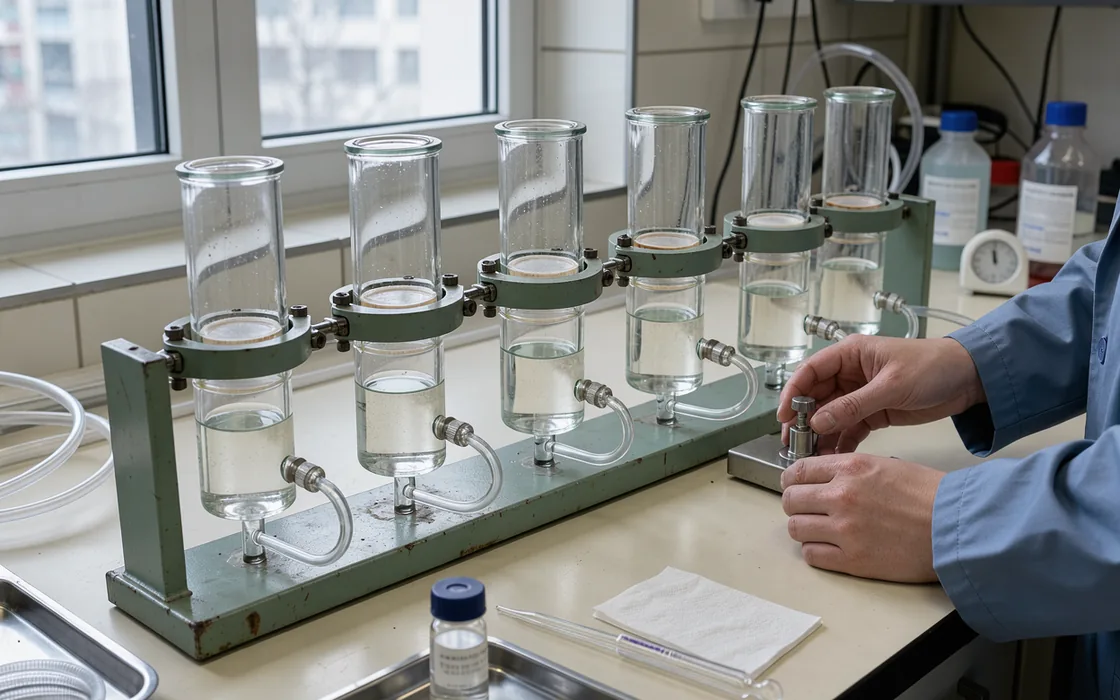
The skin-layer penetration experiment gives the discussion a tangible measurement. Copper applied as the GHK-Cu tripeptide penetrated dermatomed human skin. The experiment used human skin outside the body, with penetration examined as a function of skin layer.
Dermatomed refers to prepared skin tissue used in the experiment. This is a laboratory model with a defined preparation, rather than a measurement from somebody using a body lotion. I give it credit for addressing skin passage directly; I also retain that experimental setting when interpreting the result.
The paper reports copper delivery and a retained dermal depot. Depot here means material remaining in the skin tissue. That word can sound like a ready-made cosmetic benefit, but the measurement itself concerns where copper was found. I want to preserve the useful observation without giving it an extra outcome that the experiment did not measure.
Copper after 48 hours
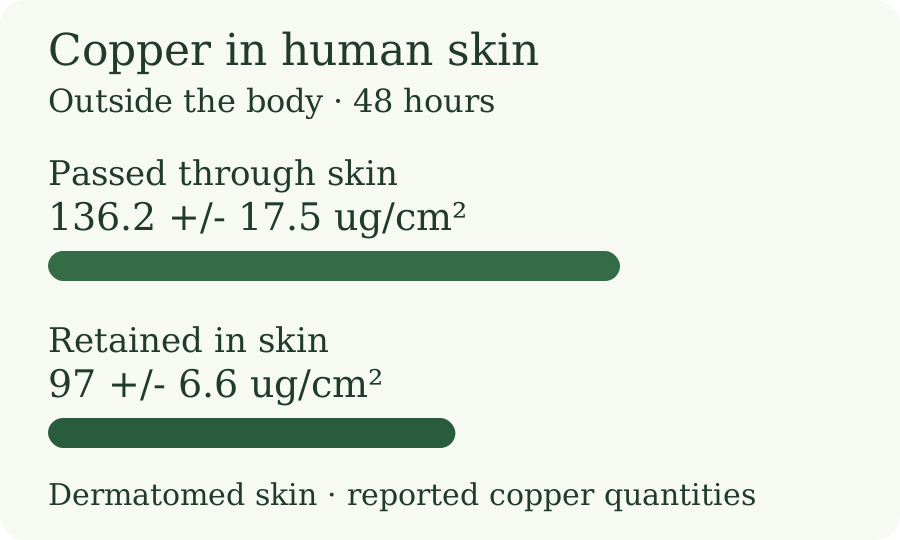
Over 48 hours, the dermatomed-skin experiment reported 136.2 +/- 17.5 ug/cm^2 of copper permeating and 97 +/- 6.6 ug/cm^2 retained as a dermal depot. The amounts are reported per area of skin. They answer separate questions: how much passed through the prepared skin, and how much remained in it.
These are copper measurements. Treating either as a quantity of intact GHK-Cu would change the measured substance. I leave the copper description attached to the figures because it is a particularly consequential noun in this experiment.
The diagram puts those reported quantities beside one another. It supplies neither a general absorption percentage for a lotion nor a result from a person applying one. The experimental setting gives the numbers their meaning, and I think they are interesting enough without borrowing a different setting.
Modified peptides and delivery strategies
The topical review evaluates palmitoylation, including a modified form called Pal-GHK, and microneedle pretreatment as ways of improving passage. These are useful research directions because they take the delivery obstacle seriously. They also make the preparation more specific.
Results involving a modified peptide or pretreated skin leave me asking about the preparation that was actually tested. The intervention has changed. A successful delivery experiment is interesting for the conditions it actually tested, and those conditions need to travel with the finding.
For a lotion, the comparison that interests me would stay with the finished formulation and its intended application to skin. The ingredient, the surrounding base and the measured outcome would all be described together. The cream results bring that question back to the whole preparation, where an answer would become most useful for the object in this site's name.